
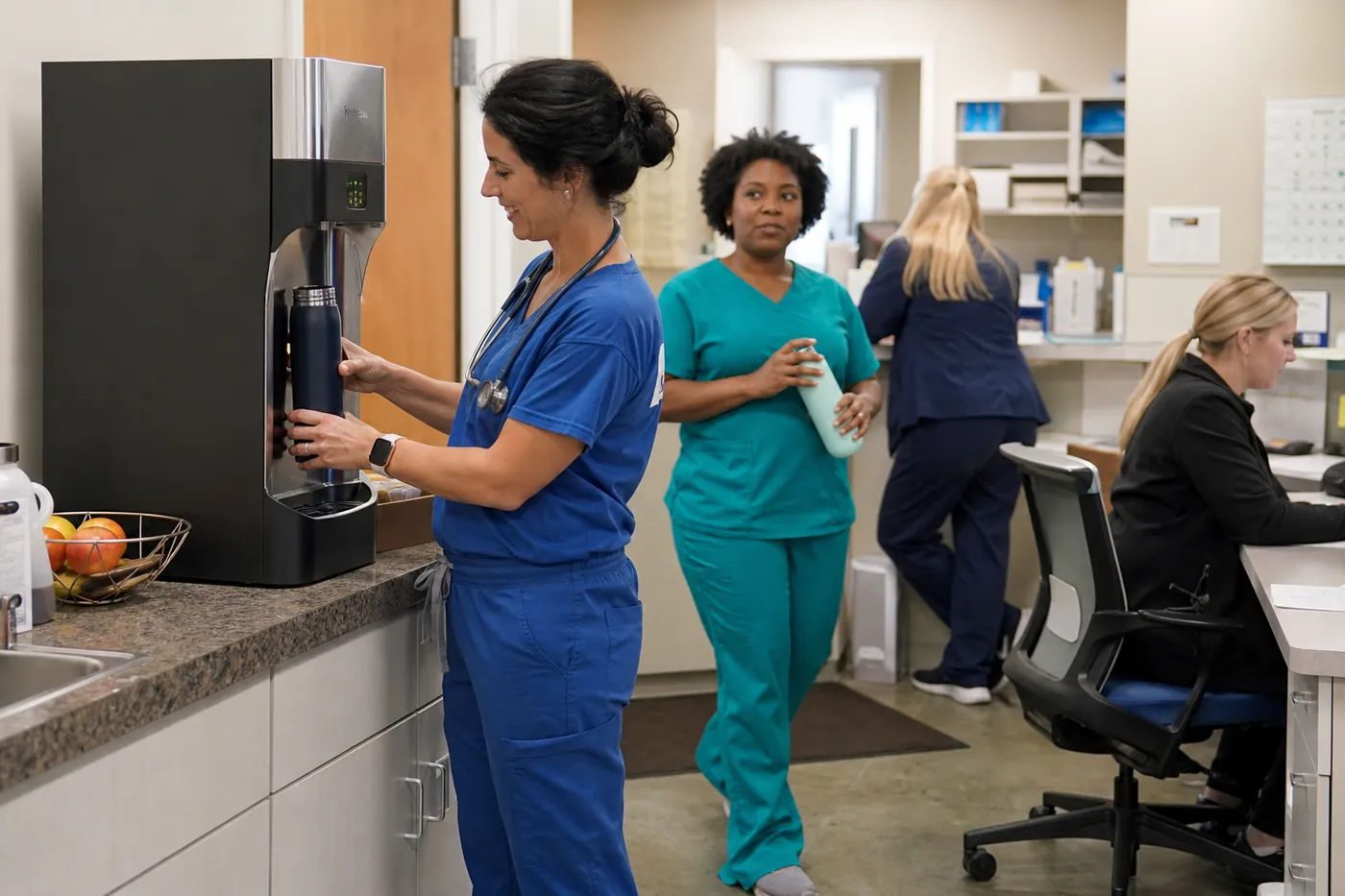
A medical practice needs more from office water service than a cooler placed wherever plumbing happens to be convenient. Clinical teams move between patient care, documentation and short breaks. Waiting rooms bring visitors with different mobility needs. Staff-only and patient-facing spaces have different cleaning, access and risk considerations. The right plan treats drinking water as a small but real facilities system with assigned ownership, documented maintenance and a reliable response path.
Start with the operating workflow rather than a dispenser catalog. Map who uses each area, when demand peaks, which surfaces the environmental-services team cleans and where a leak or service visit would interrupt care. Then compare bottleless and bottled options against those conditions. The broader office water service guide provides the purchasing framework, while the water cooler maintenance checklist helps define ongoing responsibilities.
Start with the operating environment
Separate patient and staff requirements
A waiting-room station may need simple controls, accessible placement, quiet operation and frequent exterior cleaning. A staff break-room unit may face concentrated use at shift changes and greater demand for hot water. A treatment area may be inappropriate even when it is physically convenient. Involve facilities, infection prevention and practice leadership before finalizing locations.
Plan cleaning boundaries before installation
The service provider should describe internal sanitation and filter work. The practice should assign exterior cleaning, spill response and daily observation. Those responsibilities should fit existing environmental-services procedures. Staff should know whom to contact if water tastes different, the drip tray repeatedly fills, a line leaks or the unit stops cooling.
Size for the clinical schedule
Average headcount can hide short, heavy-use periods between appointments or shifts. Compare cold-water recovery, bottle-fill clearance and dispense speed with the practice schedule. A second modest station can be more useful than one premium unit that forces clinical and administrative employees into the same queue.
Protect patient information during service
A technician may need access near workstations, records or controlled spaces. Define escort requirements, approved service hours and the route to the equipment. Water service should never require a visitor to pass unattended through areas containing protected information.
Keep records that can be audited
Record the unit, location, filter type, filter date, sanitation work, repair history and provider. Documentation makes missed service and repeat problems visible. It also supports consistent oversight when a practice has several clinics.

Illustrative planning scenario: an Alabama medical practice
The following is a representative facilities scenario based on common practice patterns, not a named-client claim. A growing primary-care group evaluating office water delivery in Alabama had a busy waiting room, a separate clinical corridor and a staff break room. Its first idea was one cooler near reception. A workflow review showed that clinical employees would cross the patient queue during short breaks, while visitors needed an accessible station closer to seating. The practical plan used a quieter patient-facing unit and a higher-capacity staff unit, with both locations added to the cleaning schedule. The choice was driven less by total headcount than by separation of users, peak timing and the need to keep clinical traffic moving.
Planning checklist
- Map patient, staff and restricted zones before discussing equipment.
- Confirm who approves placement, plumbing, electrical work and service access.
- Define internal sanitation, exterior cleaning and incident-response responsibilities in writing.
- Compare capacity against appointment waves and shift changes, not only daily headcount.
- Require unit-level service records and a clear replacement plan during repair.
- Review accessibility, slip risk, hot-water controls and the path used by service technicians.
For additional facilities context, consult CDC environmental infection-control guidance. Apply outside guidance to the actual building, equipment and local requirements rather than treating a general resource as a substitute for a site review.
Frequently asked questions
Can a medical office use a bottleless water cooler?
Yes, when source water, filtration, installation, cleaning and service access are appropriate. The practice should evaluate the exact location and maintenance plan rather than assuming every clinical area is suitable.
Should patients and employees share one dispenser?
Sometimes, but separate stations often work better when patient traffic, restricted areas or staff break timing create conflicts. Base the decision on the floor plan and workflow.
How often should a healthcare water dispenser be cleaned?
Follow the manufacturer and provider requirements for internal sanitation, and set a documented practice schedule for exterior high-touch surfaces and drip trays. Increase attention when use is heavy or local policy requires it.
What records should a practice keep?
Keep the unit identifier, location, installation date, filter and sanitation history, repairs, complaints and service contact. Multi-site groups should use the same record format at every clinic.
Compare a complete service scope
A useful healthcare proposal should explain the equipment, treatment stages, installation route, cleaning split, service access and outage response. Provide the same site facts to every bidder, then compare office water prices on a consistent scope.