
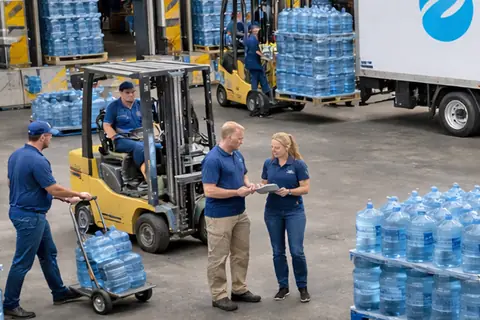
Statewide overview: California employers receive more useful office water proposals when each location is described separately and every company prices the same equipment, capacity, filtration, maintenance and support. Dense urban offices, inland facilities and widely distributed branches may need different delivery or bottleless strategies under one account standard.
Plan California office water service one location at a time
California office water delivery spans large downtown properties, suburban campuses, medical suites, creative workplaces, warehouses and small regional offices. A Los Angeles high-rise can impose loading and elevator restrictions that do not apply to a street-level Central Valley office. Bay Area employers may have tight storage and hybrid attendance, while inland facilities can experience stronger hot-weather demand. A statewide buyer should establish common quality and service standards, then document the access and usage pattern at every address.
Start with occupied floors, employee and visitor counts, shifts, meeting traffic and the number of areas that need convenient water. One high-output cooler may serve a compact office, but separate departments or secure work areas can require several points of use. Ask each bidder to show how the proposed capacity performs during the busiest hour. Bottleless cooler daily output is useful context, although actual recovery and placement still need to fit the facility.
For bottled delivery, receiving and storage deserve the same attention as consumption. Record loading rules, parking, elevator reservations, delivery windows and the place where full and empty containers will be separated. A California water bottle company should be able to explain route frequency and reserve inventory without assuming that every office can hold a pallet or accept deliveries throughout the day.
Use water quality, plumbing and storage to choose the service model
Bottleless coolers can reduce container deliveries where a potable water connection, power and maintenance access are available. Bottled plans remain practical for temporary offices, restricted leases and low-volume locations. Some multi-site California companies use both. The comparison should include the operational work retained by staff: accepting and rotating bottles on one side, or coordinating installation and scheduled filter service on the other. Bottleless office water service explains the equipment and maintenance path in more depth.
Filtration should be based on the incoming supply and building conditions, not on the longest available feature list. Ask what each treatment stage is designed to reduce, whether a drain is needed, how filter capacity was selected and who records replacements. Older property plumbing can affect taste or sediment after municipal water reaches the building. The provider should inspect the proposed location and explain how leaks, low flow or changed taste are escalated.
Sustainability goals may favor fewer delivered containers, but environmental claims should still be connected to the actual program. Consider delivery mileage, bottle handling, filter disposal, energy use and expected equipment life. A bottleless unit that is poorly sized or difficult to maintain is not automatically a better result. The answer on the value of switching to bottleless coolers helps frame the decision without reducing it to one claim.
Compare California water companies on coverage and total annual cost
California pricing should be modeled by location and then rolled up for the organization. Include equipment or rental, installation, water, filters, sanitation, delivery fees, minimums, repair coverage and price-change terms. Test a normal month and a peak month. This prevents a low base rate from winning only because another proposal includes more service. Use office water delivery prices to organize a like-for-like annual comparison.
Local reach needs evidence. For every office, confirm the route or technician territory, normal service day, missed-delivery process and repair target. A company serving Los Angeles may not use the same team or schedule in Sacramento, San Diego or a smaller retained California market. Standardized invoicing and equipment can help, but location-level contacts and records should remain visible so local problems do not disappear inside a statewide total.
The final request should identify each address, occupancy pattern, desired dispensing, delivery or filter schedule, access restrictions and response expectations. It should also state who owns equipment and what happens when an office moves or closes. Those facts encourage realistic California office water quotes and make contract exclusions easier to find. Compare California office water service prices with the same requirement for every bidder.