
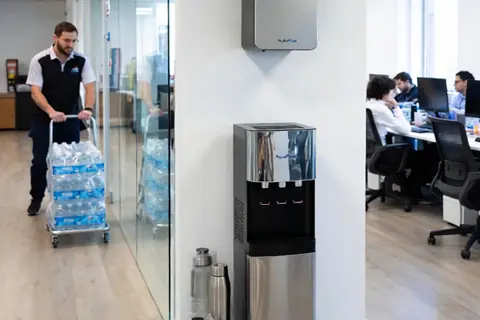
Statewide overview: New York office water service should be scoped by address, building access, occupancy and the route or technician supporting the equipment. A complete comparison includes the cooler, water or filters, sanitation, repairs, delivery constraints and contract terms behind the price.
Match New York water service to building and market
Office water delivery in New York serves New York City professional, healthcare and hospitality workplaces, Long Island employers, Albany offices, Buffalo and Rochester businesses and operations across regional communities. A Manhattan tower, suburban medical office and upstate production facility do not share the same access or route conditions. Count people by shift, guests and occupied areas before a provider recommends equipment.
Dense properties may control loading reservations, freight elevators, insurance documents and contractor hours. Regional facilities may have longer intervals between route visits. Record these facts before comparing a water bottle company or bottleless installer. Ask what happens when a service window is missed and how inventory changes are requested. Reliable office delivery requires workable building procedures.
Dispenser placement should reduce walking without crowding reception, clinical areas or corridors. Ask about chilled recovery during peak periods, hot-water use and accessibility. A multi-floor office may need several units even when one large cooler appears less expensive, because location affects whether employees actually use the service.
Compare bottled logistics with bottleless maintenance
Bottled water delivery can fit leased offices and properties where plumbing changes are restricted. It adds receiving, lifting, storage and empty pickup. Bottleless water coolers reduce container handling at permanent sites but require survey, installation, filtration, sanitation and local repair. The bottleless water service guide explains why ongoing maintenance belongs in the equipment decision.
Ask what each filter stage is intended to address and how expected water volume affected capacity. The site review should locate the supply, shutoff, power and any drainage or leak-control requirement. In regulated, clinical or laboratory settings, coordinate installation and service with access procedures and require dated records of filter changes and sanitation.
Organizations with multiple New York offices should receive location-level reporting. Bottle quantities, route exceptions, filter dates, repair calls and downtime show whether one site needs greater output and another a different schedule. Standard equipment may simplify staff use, but address-specific reach and building rules must remain visible.
Compare New York water companies on total annual value
Build a twelve-month cost model that includes equipment or rental, bottles, route charges, deposits, minimums, installation, filters, sanitation, repairs and removal. Add building fees or after-hours work when required. The hidden costs of bottled water delivery help buyers include receiving and storage work as well as supplier invoices.
Confirm which route or technician serves New York City, Buffalo, Rochester, Yonkers, Syracuse and every retained New York address. Ask how the provider handles a missed route, failed access, empty inventory, leak or cooler outage. Expected response, escalation and emergency charges should be written rather than inferred from a statewide coverage statement.
Give each finalist the same address list, attendance by shift, visitor demand, desired temperatures, dispenser features, storage, access, plumbing and service expectations. Ask for one-time charges, recurring fees, exclusions and renewal terms separately. Then compare New York office water delivery prices against the full work each proposal includes.